31, డిసెంబర్ 2025, బుధవారం

AN INTRODUCTION TO A I ...............The three main types of AI, categorized by capability, are Narrow AI (ANI) for specific tasks, Artificial General Intelligence (AGI) for human-like adaptability, and Artificial Superintelligence (ASI), a theoretical future AI that surpasses human intellect across all domains, with current real-world AI being predominantly Narrow AI


Types of Artificial Intelligence (AI)


  • ificial Intelligence refers to something which is made by humans or non-natural things and Intelligence means the ability to understand or think. AI is not a system but it is implemented in the system. There are many different types of AI, each with its own strengths and weaknesses.

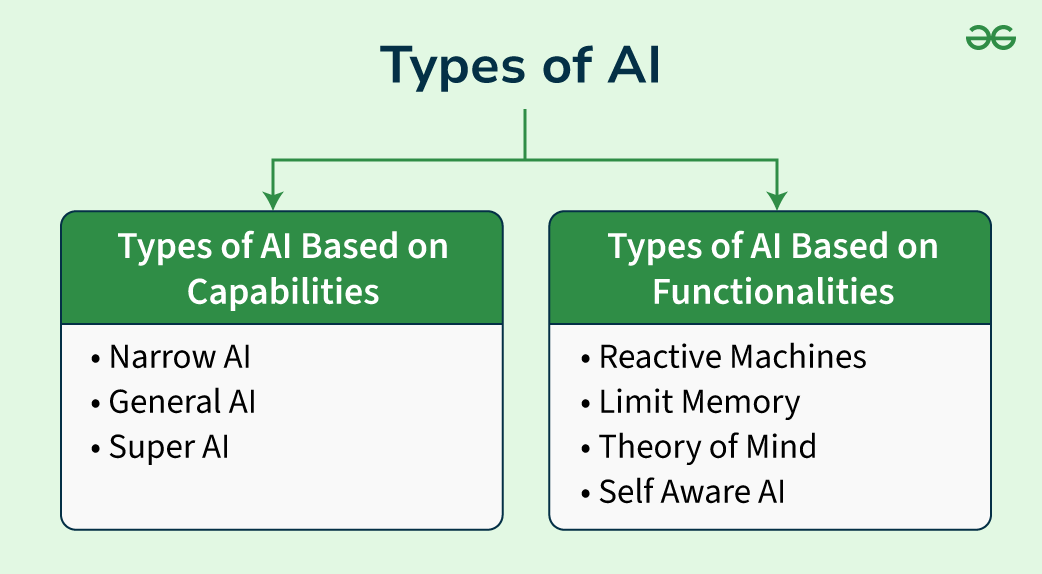
This article will explore these categories, breaking down AI into three primary types based on capabilities and four types based on functionalities.

Types of Artificial Intelligence

Artificial Intelligence (AI) has transformed industries, leading to significant advancements in technology, science, and everyday life. To understand AI better, we must first recognize that AI can be categorized into different types based on capabilities and functionalities.

Type 1: Based on Capabilities of AI

  • Narrow AI
  • General AI
  • Super AI

Type 2: Based on the Functionality of AI

  • Reactive Machines
  • Limited Memory AI
  • Theory of Mind
  • Self-Aware AI
Types-of-Artificial-Intelligence-AI

Types of AI Based on Capabilities

1. Narrow AI (Weak AI)

Narrow AI is designed and trained on a specific task or a narrow range tasks. These Narrow AI systems are designed and trained for a purpose. These Narrow systems performs their designated tasks but mainly lack in the ability to generalize tasks.

Examples:

  • Voice assistants like Siri or Alexa that understand specific commands.
  • Facial recognition software used in security systems.
  • Recommendation engines used by platforms like Netflix or Amazon.

Despite being highly efficient at specific tasks, Narrow AI lacks the ability to function beyond its predefined scope. These systems do not possess understanding or awareness.

2. General AI (Strong AI)

General AI refers to AI systems that have human intelligence and abilities to perform various tasks. Systems have capability to understand, learn and apply across a wide range of tasks that are similar to how a human can adapt to various tasks.

While General AI remains a theoretical concept, researchers aim to develop AI systems that can perform any intellectual task a human can. It requires the machine to have consciousness, self-awareness, and the ability to make independent decisions, which is not yet achievable.

Potential Applications:

  • Robots that can learn new skills and adapt to unforeseen challenges in real-time.
  • AI systems that could autonomously diagnose and solve complex medical issues across various specializations.

3. Superintelligence (Super AI)

Super AI surpasses intelligence of human in solving-problem, creativity, and overall abilities. Super AI develops emotions, desires, need and beliefs of their own. They are able to make decisions of their own and solve problem of its own. Such AI would not only be able to complete tasks better than humans but also understand and interpret emotions and respond in a human-like manner.

While Super AI remains speculative, it could revolutionize industries, scientific research, and problem-solving, possibly leading to unprecedented advancements. However, it also raises ethical concerns regarding control and regulation.

Types of Artificial Intelligence Based on Functionalities

AI can also be classified into four types based on how the systems function. This classification is more commonly used to distinguish AI systems in practical applications.

1. Reactive Machines

Reactive machines are the most basic form of AI. They operate purely based on the present data and do not store any previous experiences or learn from past actions. These systems respond to specific inputs with fixed outputs and are unable to adapt.

Examples:

  • IBM’s Deep Blue, which defeated the world chess champion Garry Kasparov in 1997. It could identify the pieces on the board and make predictions but could not store any memories or learn from past games.
  • Google’s AlphaGo, which played the board game Go using a similar approach of pattern recognition without learning from previous games.

2. Limited Memory in AI

Limited Memory AI can learn from past data to improve future responses. Most modern AI applications fall under this category. These systems use historical data to make decisions and predictions but do not have long-term memory. Machine learning models, particularly in autonomous systems and robotics, often rely on limited memory to perform better.

Examples:

  • Self-driving cars: They observe the road, traffic signs, and movement of nearby cars, and make decisions based on past experiences and current conditions.
  • Chatbots that can remember recent conversations to improve the flow and relevance of replies.

3. Theory of Mind

Theory of Mind AI aims to understand human emotions, beliefs, intentions, and desires. While this type of AI remains in development, it would allow machines to engage in more sophisticated interactions by perceiving emotions and adjusting behavior accordingly.

Potential Applications:

  • Human-robot interaction where AI could detect emotions and adjust its responses to empathize with humans.
  • Collaborative robots that work alongside humans in fields like healthcare, adapting their tasks based on the needs of the patients.

4. Self-Awareness AI

Self-Aware AI is an advanced stage of AI that possesses self-consciousness and awareness. This type of AI would have the ability to not only understand and react to emotions but also have its own consciousness, similar to human awareness.

While we are far from achieving self-aware AI, it remains the ultimate goal for AI development. It opens philosophical debates about consciousness, identity, and the rights of AI systems if they ever reach this level.

Potential Applications:

  • Fully autonomous systems that can make moral and ethical decisions.
  • AI systems that can independently pursue goals based on their understanding of the world around them.

Conclusion

The evolution of AI has led to advancements in various industries, from Narrow AI systems that simplify daily tasks to the theoretical development of Super AI. Understanding the different types of AI based on capabilities and functionalities provides a clearer picture of where we are in the AI journey and where we are heading. As AI research progresses, it's crucial to explore the ethical and societal impacts of more advanced AI systems while continuing to harness their potential for innovation.

29, డిసెంబర్ 2025, సోమవారం

fault localization, vulnerability detection in S E.........


Top 10 Emerging Technologies Every CSE Student Should Know in 2025..........


The field of Computer Science Engineering (CSE) is evolving rapidly, and for students pursuing a B.Tech in CSE, staying updated with emerging technologies is no longer optional—it’s essential. Whether you’re preparing for campus placements, planning for higher studies, or aiming to build a successful tech career, understanding the top emerging technologies in 2025 gives you a significant competitive edge in the ever-changing tech landscape.

Artificial Intelligence (AI) and Machine Learning (ML)

AI and ML continue to dominate the tech landscape. From recommendation systems to autonomous vehicles, AI is the backbone of modern innovation.

  • Applications: Chatbots, fraud detection, medical diagnostics, predictive analytics
  • Languages/Tools: Python, TensorFlow, Scikit-learn, Keras
  • Career Roles: ML Engineer, AI Researcher, Data Scientist

Blockchain Technology

Originally developed for cryptocurrencies, blockchain now powers smart contracts, decentralized finance (DeFi), and supply chain systems.

  • Applications: Crypto wallets, NFT platforms, voting systems
  • Languages/Tools: Solidity, Ethereum, Hyperledger, Rust
  • Career Roles: Blockchain Developer, Smart Contract Engineer

Quantum Computing

Quantum computing promises to solve problems classical computers can’t handle efficiently, especially in cryptography and complex simulations.

  • Applications: Drug discovery, financial modeling, secure communication
  • Languages/Tools: Qiskit, IBM Quantum Experience, Cirq
  • Career Roles: Quantum Developer, Research Scientist

Edge Computing

As IoT devices grow, data processing at the edge (near the data source) becomes essential for faster response and reduced latency.

  • Applications: Smart homes, autonomous vehicles, wearable tech
  • Languages/Tools: AWS Greengrass, Azure IoT Edge
  • Career Roles: IoT Developer, Edge Solutions Architect

Cybersecurity & Ethical Hacking

With digital threats rising, the demand for cybersecurity professionals is skyrocketing. Ethical hackers help organizations stay secure.

  • Applications: Network security, penetration testing, data privacy
  • Languages/Tools: Kali Linux, Metasploit, Wireshark
  • Career Roles: Cybersecurity Analyst, Ethical Hacker, Security Engineer

Augmented Reality (AR) & Virtual Reality (VR)

AR/VR are transforming industries like gaming, education, healthcare, and e-commerce.

  • Applications: Virtual training, 3D modeling, immersive learning
  • Languages/Tools: Unity, Unreal Engine, ARKit, Vuforia
  • Career Roles: AR/VR Developer, 3D Software Engineer

Internet of Things (IoT)

IoT connects physical devices to the internet, enabling smart automation and real-time analytics.

  • Applications: Smart cities, fitness trackers, industrial monitoring
  • Languages/Tools: Arduino, Raspberry Pi, MQTT, Node-RED
  • Career Roles: IoT Engineer, Embedded Systems Developer

8. DevOps & Site Reliability Engineering (SRE)

DevOps combines software development and IT operations for faster, reliable deployments. It’s a critical skill for modern software engineers.

  • Applications: Continuous integration, automated testing, cloud deployment
  • Tools: Docker, Kubernetes, Jenkins, GitHub Actions
  • Career Roles: DevOps Engineer, SRE, Cloud Engineer

Generative AI (GenAI)

Tools like ChatGPT, DALL·E, and GitHub Copilot are examples of GenAI that can create text, images, and code.

  • Applications: Content generation, coding assistants, design tools
  • Languages/Tools: OpenAI API, LangChain, Hugging Face
  • Career Roles: GenAI Developer, Prompt Engineer

Robotic Process Automation (RPA)

RPA automates repetitive tasks without altering existing infrastructure, helping businesses improve efficiency.

  • Applications: Invoice processing, customer onboarding, HR operations
  • Tools: UiPath, Blue Prism, Automation Anywhere
  • Career Roles: RPA Developer, Automation Engineer

Conclusion

Staying ahead in the tech game means embracing innovation. Whether you’re aiming for top tech companies or dynamic startups, knowledge of emerging technologies in 2025 will set you apart. Alpine College in Dehradun, with its premier B.Tech in CSE program, equips students with industry-relevant skills and offers strong placement support, making it an excellent choice for aspiring tech professionals.

Key Takeaways:

  • Focus on practical projects and certifications.
  • Keep updating your GitHub portfolio.
  • Follow tech blogs, GitHub trends, and developer communities.

FAQs

Q1: Which tech has the most career scope in 2025?
A: AI, ML, and Cybersecurity are leading in terms of job demand and salaries.

Q2: Can I learn these technologies without prior experience?
A: Yes, many platforms offer beginner-friendly courses. Start small and build real-world projects.

Q3: Do I need to learn all 10 technologies?
A: No. Focus on 2–3 based on your interests and career goals.

5, డిసెంబర్ 2025, శుక్రవారం

Co,Pos...............


..................Operating System CO1 to CO6" refers to the typical Course Outcomes (COs) for an OS subject, covering foundational concepts (CO1), processes/scheduling (CO2, CO3), memory/file management (CO4, CO5), and advanced topics like Linux/mobile OS (CO6), explaining key OS functions from basics to practical implementations like < process schedulingmemory allocationfile systems, and security. 

Here's a breakdown of common COs for Operating Systems:
  • CO1: Introduction to OS
    • Understanding basic concepts, history, functions, and types (batch, multiprogramming, real-time, distributed) of operating systems.
  • CO2: Processes & CPU Scheduling
    • Learning about processes, threads, process coordination, and various CPU scheduling algorithms (FCFS, SJF, Priority, Round Robin).
  • CO3: Process Synchronization & Deadlocks
    • Analyzing process synchronization mechanisms (semaphores, monitors) and techniques for handling deadlocks.
  • CO4: Memory Management
    • Understanding memory allocation (contiguous, non-contiguous), virtual memory, paging, and segmentation.
  • CO5: File Systems & I/O
    • Studying file system structures, disk scheduling, I/O management, and device management.
  • CO6: Advanced Topics
    • Exploring security, protection, networking basics, distributed systems, real-time systems, or specific OSs like Linux/Android. 
These COs progress from foundational knowledge (CO1) to detailed analysis and application (CO4, CO5, CO6), guiding students through the core components of modern operating systems.